
Once again this summer, extreme heat swept across the whole of France. Households in the Alpes-Maritimes, although relatively spared by the heatwave of June 2026, were faced with an inescapable reality: the thermal insulation of homes on the Côte d’Azur is inadequate.
Mild winters and 300 days of sunshine a year have long contributed to a delay in the thermal refurbishment of homes on the Côte d’Azur. This is, in fact, detrimental. For although thermal insulation is recognised for helping to keep homes warm in winter, it can also keep your home cool during the summer!
And with whole weeks where temperatures are well above seasonal norms, it’s time to take stock of your home’s insulation.
And the main culprit behind these heat losses is obvious: the windows and doors.
That’s right… A large proportion of heat loss – but also heat gain – comes from the openings in your house or flat.
Why does my home get so hot in summer?
When outdoor temperatures exceed 35 °C for several days in a row, as was the case during the heatwave of June 2026, many homes on the Côte d’Azur become unbearable to live in. However, contrary to popular belief, it is not solely the outdoor air temperature that is responsible for this overheating.
The main culprit is solar radiation.
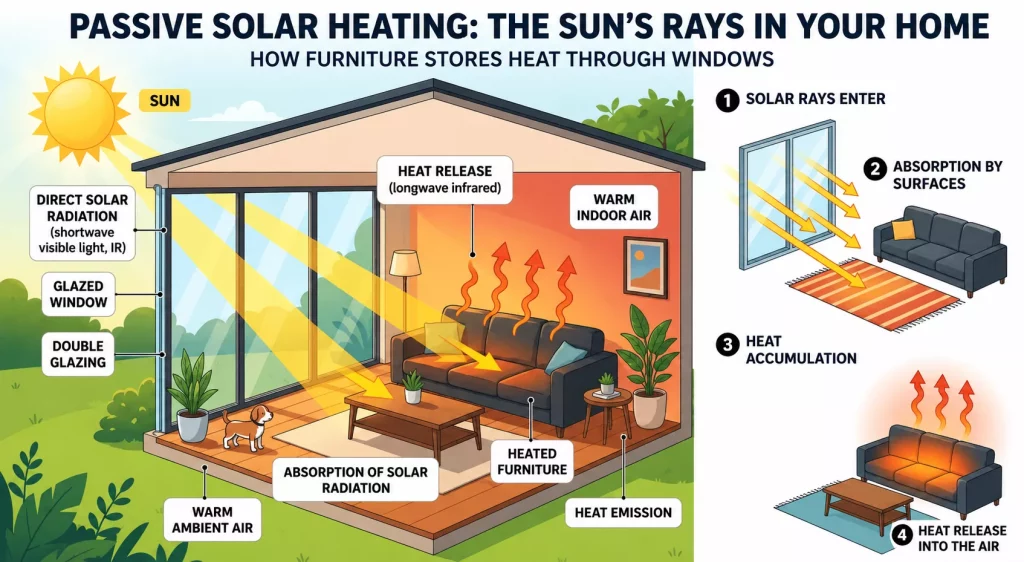
When the sun’s rays pass through a glass surface, they heat up the floors, walls, furniture and all the objects inside your home. These elements then gradually release this energy as heat, acting just like radiators. The heat can no longer escape to the outside: this is the greenhouse effect, identical to that found in a conservatory or a horticultural greenhouse.
Windows are therefore the main point of entry for heat into your home, particularly when they face south or west. Large bay windows, which are very common in flats and houses in Nice, Monaco, Villefranche-sur-Mer and Saint-Jean-Cap-Ferrat, naturally amplify this phenomenon when they lack suitable protection.
Homes built several decades ago, which still have single-glazed windows or older double-glazed windows, are particularly affected by this issue.
The Scientific and Technical Centre for Building (CSTB) points out that summer comfort depends above all on the quality of the building envelope. This includes, in particular, the walls and the roof… but also the windows, whose performance directly influences the rise in temperatures inside the home.
Does double glazing really protect against heat?
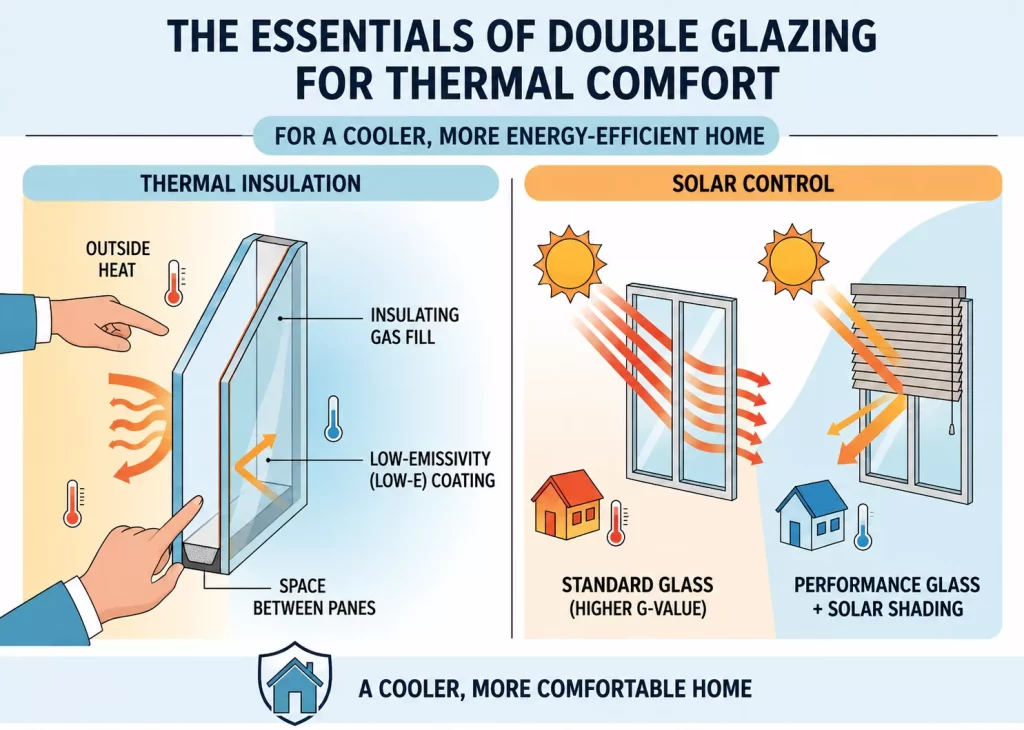
The answer is yes, but with one caveat: double glazing does not completely block out heat. However, when chosen correctly and combined with suitable sun protection, it plays a significant role in limiting heat gain and improving indoor comfort during heatwaves.
To understand how it works, we need to distinguish between two physical phenomena.
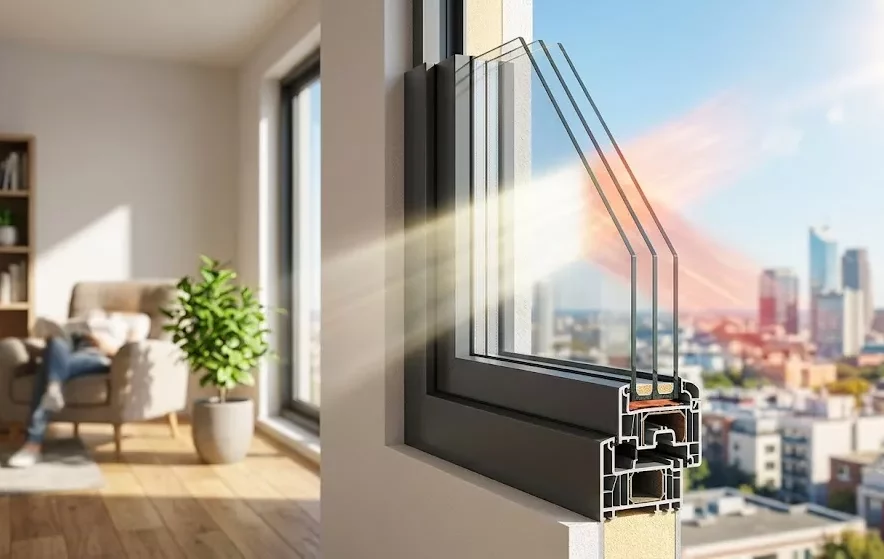
- The first is thermal conduction, that is, the natural transfer of heat between the outside and the inside. Modern double-glazed windows use two panes of glass separated by a layer of air or, more commonly nowadays, argon gas. This gas is much less conductive than air and significantly slows down heat transfer.
The most efficient glazing also features a low-emissivity (Low-E) coating. Invisible to the naked eye, this thin metallic layer reflects some of the infrared radiation and improves the window’s insulation throughout the year. - The second factor is solar radiation. As mentioned above, it is not just insulation that determines comfort in summer. The amount of solar energy passing through the glazing is just as important.
This performance is measured using the solar heat gain coefficient (Sw or g, depending on the manufacturer). The lower this value, the less heat the glazing allows to enter the home.
ADEME points out that a window’s performance should therefore not be assessed solely on the basis of its thermal transmittance coefficient (Uw), but also on the basis of its solar heat gain coefficient (Sw). These two indicators are complementary and should be taken into account when choosing your glazing.
For homes that are heavily exposed to the sun, solar-control glazing is also available. This filters out some of the solar radiation whilst maintaining an excellent level of natural light. It is particularly suitable for large south- or west-facing windows, which are very common on the Côte d’Azur.
What improvements in cooling efficiency can be expected from double glazing?
If you have chosen high-quality double glazing with a low solar heat gain coefficient, and combine this investment with the use of shutters or blackout curtains, you will see tangible results:
- Rooms will heat up more slowly
- You will need to use your air conditioning at a lower setting.
In practical terms, your home will heat up more slowly and to a lower temperature, which will allow your air-conditioner, if you have one, to regulate its output more effectively.
If you do not have an air-conditioner, shade will be your best ally. Protect your home from direct sunlight; the double glazing with a low solar heat gain coefficient will do the rest.
Why are homes on the Côte d’Azur particularly affected by the heatwave?
In Monaco, Nice, Villefranche-sur-Mer, Beaulieu-sur-Mer, Saint-Jean-Cap-Ferrat, Antibes and Cannes, many homes feature large windows designed to make the most of natural light all year round. However, this architectural style also allows excessive solar gain during the summer months, when glazing or external shading systems are no longer sufficient.
Heatwaves, which are now more frequent and intense, exacerbate this problem. Furthermore, most homes on the Côte d’Azur date from the 1960s to the 1990s and are still largely fitted with single glazing or poor-quality double glazing. This is down to an extremely strained construction sector where the pursuit of immediate profit has long taken precedence over concerns about thermal comfort in summer.
Do you live in the Alpes-Maritimes?
Whether you live in Nice, Menton, Villefranche-sur-Mer, Beaulieu-sur-Mer, Saint-Jean-Cap-Ferrat, Cannes or the surrounding area, Monaco Fenêtres can help you replace your windows, bay windows, shutters and sun protection systems to bring lasting improvements to the comfort of your home, in both summer and winter.
For residents of Monaco, you have until 2028 to replace your windows
If you live in the Principality, there’s now one more reason to consider renovating your windows.
Effective September 1, 2025, the Prince’s Government has expanded its subsidy program for replacing old single-pane windows. The goal is clear: to accelerate improvements in the energy efficiency of buildings and prepare for a major regulatory change.
In fact, starting in September 2028, single-pane windows will be phased out in both existing and new buildings, in accordance with the guidelines established by the Principality.
The new Ministerial Decree No. 2025-407 significantly increases the subsidy amounts:
- up to €600 per window for the first five windows in a residence;
- an overall cap increased from €20,000 to €40,000 per beneficiary;
- the extension of the program to the common areas of residential or mixed-use buildings.
This assistance is intended for owners of residential properties and condominiums located within Monaco, provided that the work is performed by a construction company based in Monaco.
As a Monegasque company that has specialized in exterior woodwork for many years, Monaco Fenêtres supports its clients at every stage of their project. Our teams can also assist you in preparing the administrative application for the grant, to simplify the process and ensure you receive the financial assistance for which you are eligible.
Your mostly asked questions
Yes, provided you choose high-performance double glazing with a low solar heat gain coefficient (Sw or g, depending on the manufacturer). It is even more effective if it is fitted with a low-emissivity coating.
Provided the right conditions are in place (use of shading, ventilation and high-performance glazing), double glazing can reduce the temperature in a room by 2 to 4 degrees, depending on its aspect and floor area.
Double glazing with enhanced insulation will be more effective than triple glazing. Triple glazing is primarily designed for very cold climates, so it is of little use against heatwaves.
Windows are just one part of a building, and even high-quality double glazing will be ineffective if the shutters or curtains are left open and the roof is poorly insulated.
In a region with plenty of sunshine, glazing with enhanced insulation combined with solar control is the best option. It helps retain heat in winter and prevents the greenhouse effect in summer, whilst still letting in sunlight.